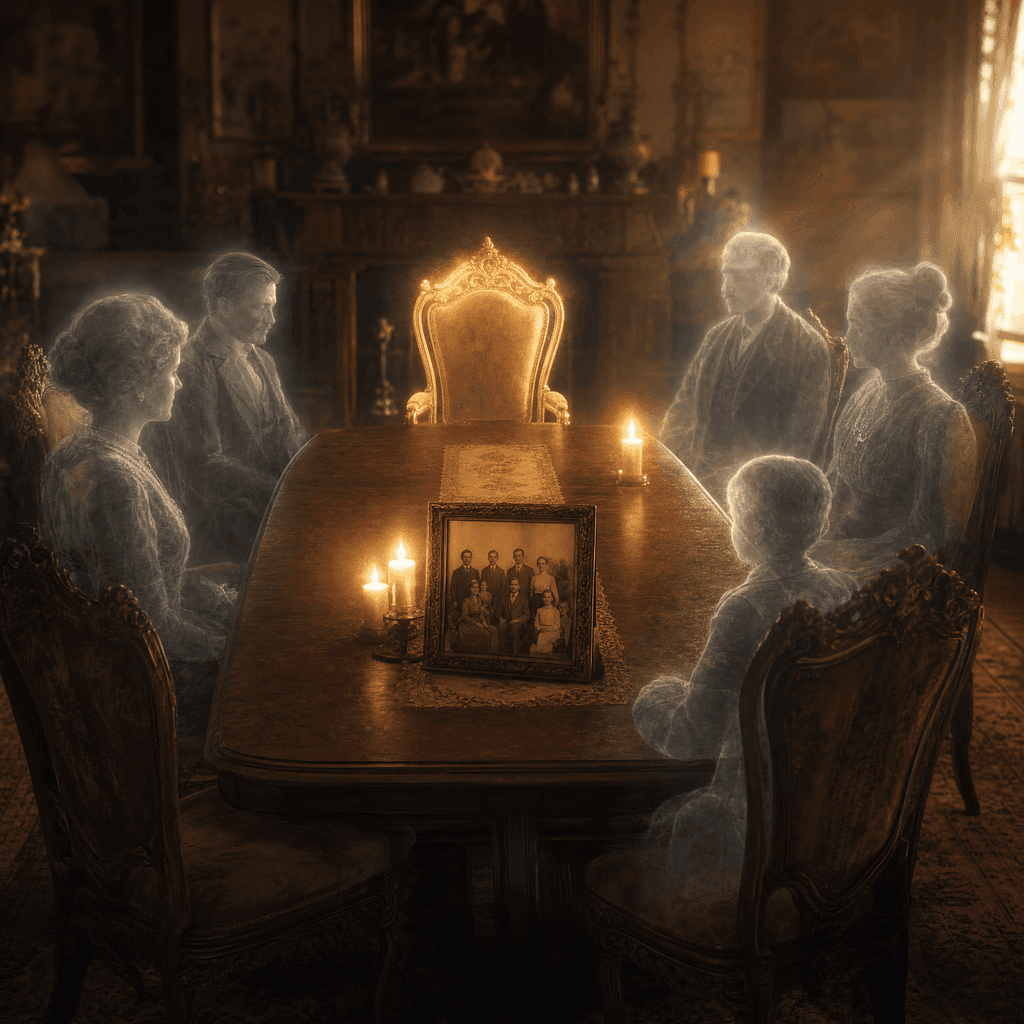
Key Takeaway: The feeling of not finding your place in the family is almost never a simple matter of personality. It is rooted in sibling dynamics, birth order, and above all in transgenerational loyalties you are not aware of. Psychogenealogy helps you understand this family dynamic, and finally reclaim your rightful place.
You walk into a room and feel like you're one too many. You succeed, yet something whispers that this isn't really your life. Even within your own family, you sometimes feel like a guest, never quite in your place, never quite at home.
This "vertigo of place" is one of the most quiet and widespread forms of suffering. It's often mistaken for a lack of confidence or a difficulty asserting oneself. But behind this unease frequently lies a far deeper question: what place was I actually assigned in my family system, and to whom does it really belong?
This is exactly what psychogenealogy allows us to explore.
Why Is It Sometimes So Hard to Find Your Place?
Finding your place within your family is never automatic. Every child arrives into an already-formed system, with its own history, its grief, its expectations, and its unspoken words. The place we occupy depends on far more than our personality: it depends on the context into which we were born.
Several factors come into play:
- Birth order: being the eldest, the middle child, the youngest, or an only child does not carry the same expectations or roles.
- The unconscious parental project: some children are born to "repair" a couple, replace someone who died, or continue a dream their parents never fulfilled.
- Invisible loyalties: those silent commitments that bind us to previous generations and assign us a mission we never chose.
When the place reserved for us doesn't match who we truly are, a lasting sense of misalignment sets in.
Birth Order and Your Place Among Siblings
Your place among siblings has a real impact on a child's development and sense of self. It isn't destiny, but it is a valuable lens for understanding why each person, within the same family, occupies such a different position from their brothers and sisters.
The Eldest: The Thankless Role of the Trailblazer
As the firstborn, the eldest often carries a share of parental responsibility. They sometimes play a second-parent role toward their younger siblings, must set the example, and "succeed" for the family. This place, rewarding on the surface, can become demanding and exhausting. Many eldest children struggle, in adulthood, to allow themselves to exist for who they are rather than for others.
The Middle Child and the Youngest: Existing Between the Lines
The middle child often seeks to stand apart from the eldest, to find a path of their own. The youngest occupies the place of the "little one", the one who is protected, sometimes the one never quite allowed to grow up. Rivalry, jealousy, the need for recognition: these dynamics between siblings shape personality at a deep level.
The Only Child and the Forgotten Middle
The only child concentrates all parental expectations, with no way to share them. The middle child can feel invisible, caught between the eldest who leads and the youngest who is cherished. Each, in their own way, must find how to assert themselves and gain autonomy in adulthood.
Understanding your place among siblings already means putting words to a diffuse feeling. But birth order doesn't explain everything. To understand why certain places are so deeply uncomfortable, we must go further back along the family line.
When Your Place Comes From Previous Generations
This is where psychogenealogy offers insight that analyzing sibling dynamics alone cannot provide. Our place in the family is not determined solely by our parents: it is shaped by everything that played out before us.
Transgenerational transmissions operate in several ways:
- The place of someone who died: a child may be unconsciously assigned to occupy the place of a deceased older brother, an uncle lost to war, an unwanted child, or an interrupted pregnancy. They then live a life that is not quite their own.
- The mission of repair: carrying a parent's broken dream, "succeeding" where an ancestor failed, consoling a grieving lineage. These invisible missions trap a person in a place they never chose.
- Repeated exclusion: some families systematically exclude one member in each generation: the black sheep, the one who leaves, the one no longer named. This pattern can be passed down and strike a descendant who is in no way responsible.
When you carry someone else's place, you literally cannot occupy your own. Hence that persistent feeling of belonging nowhere. This transgenerational trauma is one of the mechanisms also found in replacement child syndrome, where the child lives in the shadow of someone who died.
The Signs That Should Alert You
How do you know whether your difficulty finding your place stems from a transgenerational burden? Certain signals come up often among the people I support:
- A permanent sense of misalignment, even surrounded by those you love.
- The feeling of living "beside" your own life, without flavor or legitimacy.
- A chronic difficulty asserting yourself or feeling that you matter to others.
- The need to take care of everyone, at your own expense.
- A diffuse anxiety, sometimes long-standing, whose origin you cannot find.
- The sense of having a "debt" to pay to the family, without knowing which one.
These signals are not flaws. They are the language of a family unconscious trying to make itself heard.
How Psychogenealogy Helps You Reclaim Your Rightful Place
Working within psychogenealogy is not about blaming your family for anything. It is about understanding the family dynamic that assigned you this place, so you can leave it and reclaim your own.
Step 1: Map the Family System
The first step is to build a genosociogram, a map of your family tree enriched with emotional bonds, key events, grief, exclusions, and secrets. Across at least three generations, this work often reveals, far better than any introspection, why your place feels so uncomfortable.
Step 2: Identify Inherited Loyalties and Places
From this map, we identify together the invisible loyalties at work: does the place you occupy truly belong to your story, or to that of an ancestor? Are you loyal to a suffering that is not your own? Naming these mechanisms is already the beginning of freeing yourself.
Step 3: Symbolic Acts of Repair
Psychogenealogy, much like family constellations to which it is closely related, uses powerful symbolic tools: symbolically returning a place to the person it belongs to, writing to an ancestor, rehearsing new phrases that give you permission to exist fully. This work acts deeply on identity and brings lasting peace.
"For a long time I believed I would never find my place. In reality, I was carrying my uncle's (he died before I was born). The day I understood it, I could finally breathe." Testimonial from a client supported through online consultation, 2025
Reclaiming Your Place Means Allowing Yourself to Live Your Own Life
If you recognize yourself in this vertigo of place (that feeling of belonging nowhere, of living beside your life, of carrying a weight whose origin you cannot identify), know that it is neither a whim nor a weakness.
It is often the sign of a deep loyalty to your lineage. And that loyalty can be transformed: no longer a prison, but a living tribute to those who came before you, while finally allowing yourself to occupy your place, fully.
Psychogenealogy does not ask you to reject your family. It invites you to honor your family history without carrying what does not belong to you, and to reconnect with who you truly are.
This work follows naturally from understanding transgenerational trauma, which sheds light on how wounds travel across generations.
Ready to reclaim your rightful place?
Book a psychogenealogy session with me, available online from anywhere in the world or in person at my practice in Dubai. Together, we'll build your genosociogram and identify the place that truly belongs to you, so you can finally feel at home within yourself.