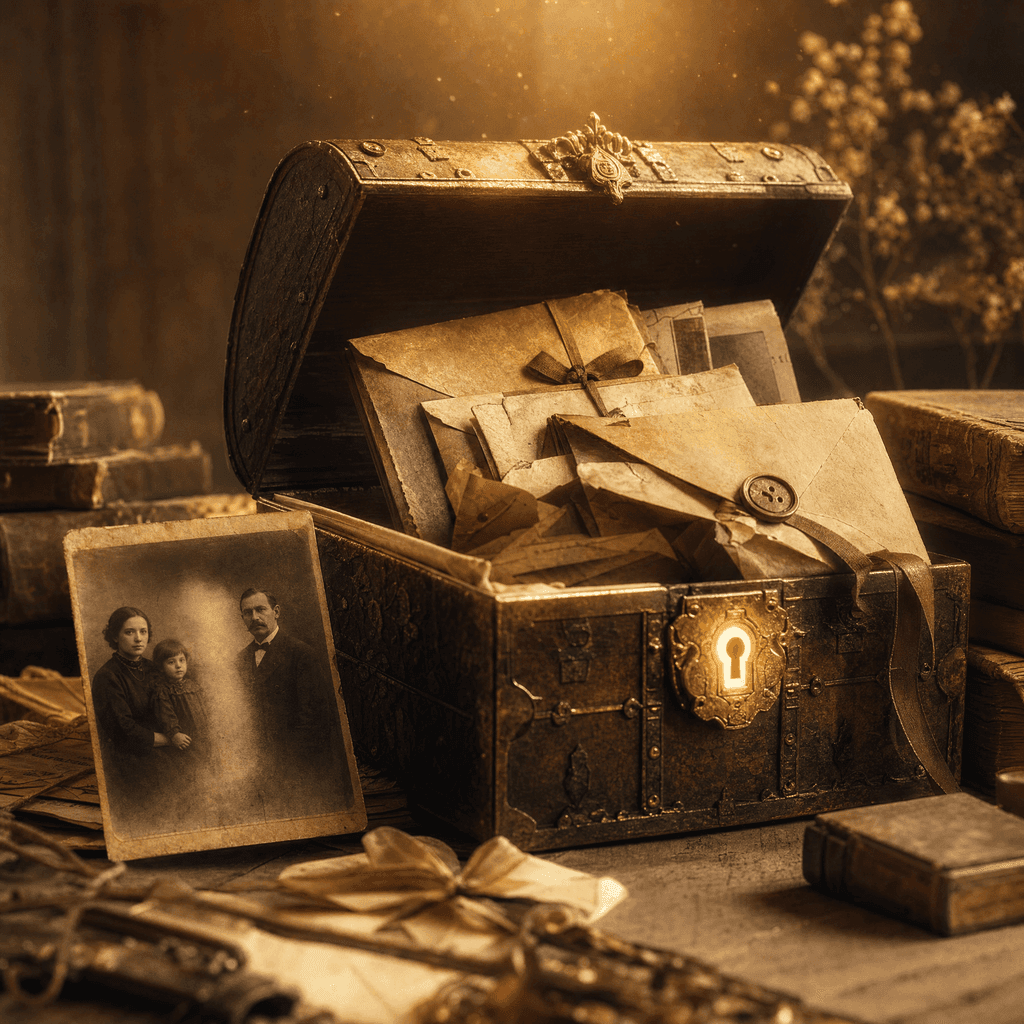
Key Takeaway: Family secrets and unspoken words never disappear: they are silently passed down from generation to generation until they surface in a descendant as anxiety, a phobia, or an unexplained symptom. Psychogenealogy makes it possible to identify these silences, and break free from them.
You feel an anxiety whose origin you cannot find. An irrational fear, an old sadness, a diffuse unease that matches nothing in your own story. You "have everything to be happy," and yet something resists, quietly.
What if this malaise did not come from you, but from what your family never said?
Family secrets and unspoken words are among the most powerful (and most silent) transmissions of the family unconscious. What is kept quiet does not disappear: it is passed down, sometimes across several generations, until it resurfaces where you least expect it.
What Is a Family Secret?
A family secret is information deliberately hidden from certain members of the family group because it is considered shameful, painful, or unspeakable. Every family has its grey areas, but some secrets weigh far more heavily than others.
The most common family secrets often involve:
- Hidden births: an illegitimate child, adultery, concealed paternity, a child born of incest.
- Silenced grief: a stillborn child, a miscarriage, a suicide passed over in silence.
- Events deemed shameful: bankruptcy, prison, mental illness, a "shameful" disease, institutionalization.
- Tragedies of history: collaboration, deportation, exile, violence suffered or inflicted.
What turns a fact into a secret is not its objective seriousness, but the shame and the silence that surround it.
Secret, Unspoken, Lie: What Are the Differences?
These three forms of silence do not have the same impact on descendants. Distinguishing them is essential in psychogenealogy.
- The family secret: information intentionally hidden from some. We know there is something, but not what.
- The unspoken (non-dit): what is never talked about, without necessarily wanting to hide it. A taboo subject everyone avoids, out of modesty, fear of conflict, or habit.
- The family lie: the conscious distortion of reality, an official version that replaces the truth.
The psychiatrist and psychoanalyst Serge Tisseron showed that it is not so much the content of the secret that is pathogenic, but the fact that it can be sensed without being named. The child involuntarily picks up the silences, the discomfort, the shifts in tone, all this "meta-communication" around what is left unsaid.
How Unspoken Words Are Passed Down Across Generations
This is where the heart of the phenomenon lies. A well-kept secret does not remain inert: it acts, in silence, and is transmitted.
Serge Tisseron describes a transmission across three generations:
- First generation: the one who lives through the event and decides to keep it quiet. The secret is conscious. It shows up in allusions, avoidances, forbidden zones.
- Second generation: the children sense that a secret exists, without knowing its content. They feel a void, a strange presence, a question impossible to ask. This is the unspeakable.
- Third generation: the grandchildren inherit not the secret itself, but its very existence, now inconceivable. This is the unnameable, which then manifests as symptoms: anxieties, phobias, unexplained disorders.
Psychoanalysts Nicolas Abraham and Maria Torok named this unconscious transmission the "phantom": what haunts a descendant is not their own lived experience, but the repressed secret of an ancestor. This mechanism connects directly to transgenerational trauma.
The Telltale Signs of a Family Secret
How do you know whether your difficulties carry the trace of a family silence? Certain clues come up often:
- Unexplained anxiety or a phobia, with no link to your personal history.
- A sense of emptiness, a diffuse malaise, or a sadness that does not belong to you.
- Disturbing repetitions: the same critical ages, the same accidents, the same failures from one generation to the next.
- A forbidden zone in the family: a subject that makes voices drop, a member no longer mentioned.
- Disproportionate reactions to certain events, anniversary dates charged with anxiety.
- The feeling of carrying a weight that is not yours.
The body and the psyche often express what words could not say. It is also through these indirect channels that what was buried reveals itself.
Should a Family Secret Always Be Revealed?
This is a delicate ethical question, and the answer is not universal. Revealing a secret abruptly can be violent; keeping it quiet indefinitely can be destructive.
In psychogenealogy, the goal is not so much to disclose the secret at all costs as to lift the pathogenic silence that surrounds it. It is about giving a place back to what was excluded, putting words where there was only a void.
Sometimes the exact content of the secret remains inaccessible: the ancestor has died, the records are gone. But recognizing that there was a secret, giving it symbolic existence, is often enough to soothe the descendant who carried its weight.
How Psychogenealogy Helps Break the Law of Silence
The therapeutic work is not about judging the family that kept quiet, as the silence was often a protection. It is about freeing the descendant from the weight they carry without knowing it.
Mapping the Silences
Building the genosociogram makes it possible to spot the grey areas: the blanks in the tree, the vague dates, the "forgotten" members, the unexplained ruptures. These voids often speak louder than the facts themselves.
Linking the Symptom to the Family History
The heart of the work is to connect what you experience today (the anxiety, the phobia, the repetition) with what played out in the lineage. That moment when the connection is made is often profoundly liberating.
Symbolic Acts of Repair
As with all transgenerational work, symbolic acts make it possible to put words back and restore a place: writing to the ancestor who carried the secret, symbolically naming what was silenced, completing the mourning left suspended. Putting words where silence reigned is what defuses the phantom.
"I'd had panic attacks since adolescence, for no reason. Going back through my family tree, we discovered a sister of my grandmother's, institutionalized and erased from the family memory. The day I gave her back her place, my anxiety eased." Testimonial from a client supported through online consultation, 2025
You Don't Have to Carry the Silence of Your Whole Lineage
If you recognize yourself in this anxiety without origin, in these disturbing repetitions, or in this feeling of carrying a weight beyond you, know that you are not condemned to pass it on in turn.
Family secrets and unspoken words don't need to be dug up at all costs. They need to be acknowledged, so they stop acting in the shadows. This is the whole purpose of psychogenealogical work: turning a heavy silence into soothed words, and setting you free within your own story.
Ready to put words to your family's silences?
Book a psychogenealogy session with me, available online from anywhere in the world or in person at my practice in Dubai. Together, we'll explore your family tree to connect your malaise to its origin, and free you from the weight of the unspoken.